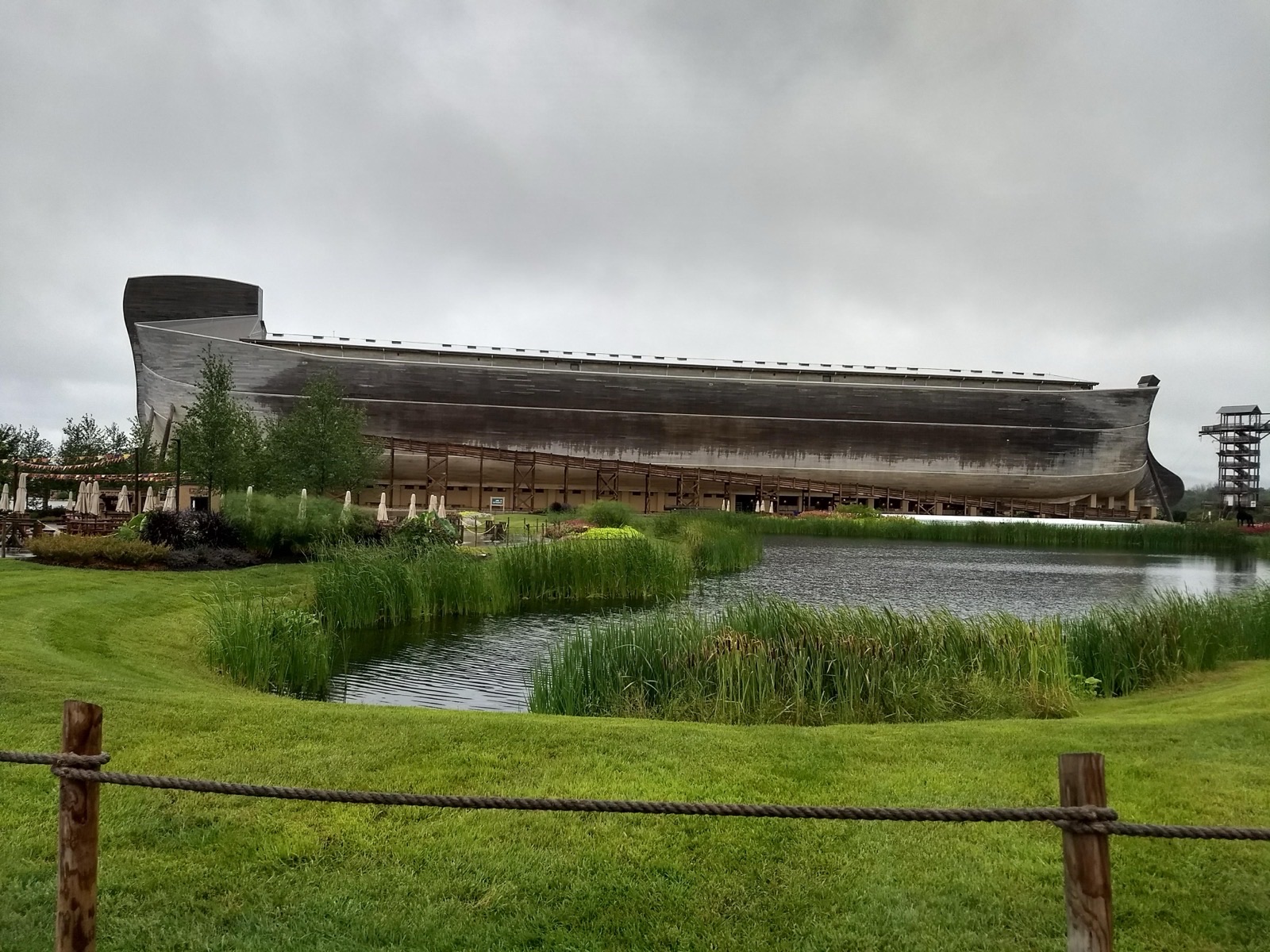
The Ark Encounter, a full-size Noah's Ark replica in Williamstown, Kentucky, built by Answers in Genesis and opened in 2016. Photograph by Acdixon, CC0 1.0 (public domain), via Wikimedia Commons.
A reader saw photos of the full-size ark replica people keep visiting and wrote in confused — it's built like a ship, but they'd always heard the ark was just a box
A reader asked: “There's a full-size copy of Noah's Ark somewhere in the Midwest that somebody actually built — and in every photo, it looks like a ship, with a curved hull and a pointed front end. But I always thought the Bible describes the ark as basically a big rectangular box. So which is it?”
The short answer: the text describes a box, and the replica the reader is thinking of made a deliberate, disclosed choice to build something else. The Hebrew word Genesis uses for the ark, tevah, means a chest or box — not any of Hebrew's words for a ship — and the only measurements the text gives are a length, a width, and a height, with no hull curve, no bow, no stern specified at all.[7] The building the reader almost certainly means — the Ark Encounter, in Williamstown, Kentucky, just south of the Ohio River near Cincinnati (officially the South census region, not the Midwest, though it's a short drive either way) — is shaped nothing like a box. It has a curved, tapered bow and stern, and its own builders have said plainly, in print, why they gave it one: not because the text requires it, but because they think the proportions the text does give hint at something more ship-like. What follows is the word, the numbers, both sides' engineering claims, and one real 450-foot wooden hull that actually went to sea — so the reader has the whole case, not just a photo.
What the word Genesis actually uses
This project's own translator's note on Genesis 6:14 puts it plainly: tevah means a chest or box, and the ark's description carries no sail, no rudder, no oars — nothing that steers a vessel, because in the story God directs it, not a crew.[7] The word shows up in exactly one other Bible story, and it's a telling one: the little waterproofed basket that carries the infant Moses down the Nile is also called a tevah (Exodus 2:3) — a small box, not a boat of any kind, doing exactly the same job Noah's tevah does at enormous scale: keeping something precious afloat and sealed against water it was never meant to be steered through. English "ark" actually preserves this correctly — it comes from the Latin arca, "chest," and only sounds nautical today because this one story made the word famous.
That said, a "box" here still has to do a boat's actual job. The very same verse that names it a tevah also commands Noah to seal it with pitch, inside and out (kafarta… bakofer) — real waterproofing, for a vessel that is genuinely going to sit in real water for real months.[7] The text's vocabulary says box; the text's own instructions say something that has to float and hold a seal like a hull. Both things are true at once, and neither one is Genesis describing a curved exterior — that part, the text simply doesn't say.
The numbers, and the shape they don't quite specify
Genesis 6:15 gives three numbers: 300 cubits long, 50 wide, 30 high — on this project's own cubit estimate (about 18 inches), roughly 450 × 75 × 45 feet, a 6:1 length-to-width ratio.[7] That ratio is the single strongest piece of evidence on the "ship-like" side of this question, and it's worth being precise about why: this project's own note on those verses points out that 6:1 is "far more shiplike than the cube-shaped ark of the Babylonian flood stories" — the earlier Mesopotamian flood epics describe a vessel that is a literal cube, equal on every side, which is about as pure a "box" as a box gets.[7] Genesis's elongated proportions are a real, measurable departure from that older tradition, and a 6:1 ratio does sit in the range naval architects consider stable for a floating, non-sailing hull.
But a ratio is not a hull curve. A plain rectangular box built at exactly 300 × 50 × 30 cubits satisfies Genesis's numbers just as completely as a tapered, ship-shaped hull built at the same three dimensions — the text's own measurements don't distinguish between them. The most detailed attempt to settle which shape performs better at sea is a 1993 study by Korean naval researchers who tank-tested twelve different hull forms at 1/50 scale, reporting that the ark's own proportions could handle waves up to roughly 100 feet and that none of the twelve alternatives significantly outperformed the biblical design on the combined standard of stability, comfort, and hull strength.[1] That finding is genuinely interesting and is routinely cited as neutral naval science — it's worth knowing, then, that the study was commissioned by a Korean creationist organization and published in a creationist technical journal, not a peer-reviewed naval-engineering one.[1] That doesn't make the tank tests fake; it does mean the result hasn't been through the same scrutiny a mainstream hull-design paper would face, which is a different thing from "proven."
Two researchers built it as a ship anyway, and said so in writing
The clearest answer to "why does the real one look like a ship" is that the people who designed it told everyone why, years before it opened. Tim Lovett — a mechanical engineer and young-earth creationist researcher who spent years building and tank-testing scale ark models, and later published a book on the subject — wrote the case for Answers in Genesis in 2007: Scripture "gives no clue about the shape of Noah's Ark beyond its proportions," so a plain rectangular box and a more ship-like hull are both honest readings of the same three numbers, and AiG opted for the latter.[1] His reasoning leans hard on that 6:1 ratio: "the proportions are so obviously ship-like that it makes sense that it should look and act like a ship, too," and a longer, tapered hull resists "broaching" — turning dangerously sideways in a following sea — better than a blunt-ended box does.[2] That's an inference from the proportions, offered as one, not a translation of anything Moses wrote.
The Ark Encounter itself opened July 7, 2016, in Williamstown, Kentucky, built by Answers in Genesis for a reported cost above $100 million.[4] Using a longer cubit than this project's own estimate (about 20.4 inches instead of 18), its own numbers come out to 510 × 85 × 51 feet — a different foot measurement, but the identical 6:1 ratio Genesis gives either way.[4] Its design team, led by Patrick Marsh, gave it the curved, tapered bow and stern the reader described; Answers in Genesis's own construction blog called the result "curvy," and framed the curve as "essential to the overall comfort, stability, and balance of the ship" — ship-design language, applied by choice.[3] One honest wrinkle worth knowing: despite the exterior, the Ark Encounter's own engineering is, in its own description, "more a building than a boat" — it sits fifteen feet up on concrete piers and masonry shear towers built to shed a 100-mph wind like any large building, not a hull ever tested in actual water.[4] The ship shape is a real, disclosed design decision about what the ark probably looked like. It has never been asked to prove that shape by floating.
Would a wooden hull that size actually survive, box or boat?
There's a real-world data point neither side's tank tests can substitute for: an actual wooden vessel built near the ark's own length. The six-masted schooner Wyoming, launched in 1909 in Bath, Maine, was 450 feet long — on this project's own 18-inch-cubit math, almost exactly Genesis's own figure for the ark — and remains the largest wooden ship ever built.[5] Even with iron cross-bracing added at the yard, her hull chronically flexed at sea — "hogging" when empty, "sagging" when loaded — opening gaps in her planking that her pumps had to fight constantly just to keep her afloat in ordinary weather.[5] In a nor'easter off Cape Cod in March 1924, the twisting worked faster than the pumps could answer it; Wyoming sank near Pollock Rip Shoal with thirteen of her crew aboard.[5] A 1983 engineering critique of the ark story, still one of the most-cited pieces on this question, puts a number on why: wooden-hull construction runs into a genuine "upper limit, in the region of 300 feet," beyond which the ship's own weight and buoyancy stop distributing evenly and the hull deforms.[6] That 1983 piece predates, and doesn't engage with, either the 1993 Korean tank tests or Lovett's later hull-curve argument — but it's the plain mainstream-engineering baseline both of those are answering, and Wyoming is the closest thing to a controlled real-world result either side has: a comparably long wooden hull, built by professional shipwrights with period steel reinforcement, that still could not hold itself together in one bad storm. One honest caveat: Wyoming was a rigged sailing schooner, carrying mast and sail loads the ark — built with no sail at all — never would have faced, so it isn't a clean substitute for the ark under flood conditions. It's simply the best real ship the question has to measure against, on either shape.
So — box, boat, or something the text just leaves open
Both halves of the reader's question are correct, pointed at different things. Genesis's own vocabulary, and everything it actually specifies, describes a box: a word that means chest, three measurements, no hull, no bow, no sail. Genesis's own proportions are also a real, measurable step away from that word's plainest sense — a 6:1 ratio no ancient box-shaped container needs and no earlier flood story bothers with. Whether that ratio is a hint toward a curved hull, or just what you get from maximizing the carrying capacity of a giant crate, is an inference either way — not something the text settles, and not something this library is equipped to referee from a distance. What the full-size replica in Kentucky shows a visitor is one considered, disclosed answer to a question Genesis left open, built by people who say plainly why they chose it. It is a real building people can walk through. It has never been a boat that has been to sea.
External sources
- Tim Lovett, “Thinking Outside the Box: Size and Shape of the Ark,” Answers in Genesis, March 19, 2007 — the box-vs-ship-like design options, and its summary of Hong, S.W. et al., “Safety Investigation of Noah's Ark in a Seaway,” Creation Ex Nihilo Technical Journal 8(1):26–35, 1994 (the 1993 KRISO tank-test study, commissioned by a Korean creationist organization and published in a creationist technical journal rather than a peer-reviewed naval-engineering one). answersingenesis.org
- Tim Lovett, “A Streamlined Noah's Ark?” Answers in Genesis, May 4, 2007 — the case for a curved, ship-like hull built on the ark's stated proportions. answersingenesis.org
- “The Ark Looks Like an Ark!” Ark Encounter construction blog (Answers in Genesis), March 16, 2016. arkencounter.com
- “Ark Encounter,” Wikipedia, for the replica's dimensions, cubit length used, opening date, construction cost, and its own engineering description as sitting on concrete piers and shear towers rather than a tested hull.
- “Wyoming (schooner),” Wikipedia, for the largest wooden ship ever built, its chronic hogging/sagging in service, and its March 1924 sinking off Cape Cod.
- Robert A. Moore, “The Impossible Voyage of Noah's Ark,” Creation/Evolution 4(1), Winter 1983, archived by the National Center for Science Education — the mainstream engineering case for a length limit on wooden-hull construction. ncse.ngo
- This project's own translator's notes on Genesis 6:14 (“the ark is a box, not a boat”) and Genesis 6:15–16 (the dimensions, and the comparison to the Babylonian flood epics' cube-shaped ark).
First published on Dear Mr. Librarian, September 27, 2026.