A standing page on the oil war, rewritten as it moves. As of October 10: Gulf crude exports recovered to around pre-war levels in September, by pipeline and by shuttle tanker rather than through an open strait, but tanker attacks hit a wartime high in early October; Brent settled at $104.72, 44% abo
The Librarian · Updated · 42 min read · 0 comments · 0 views
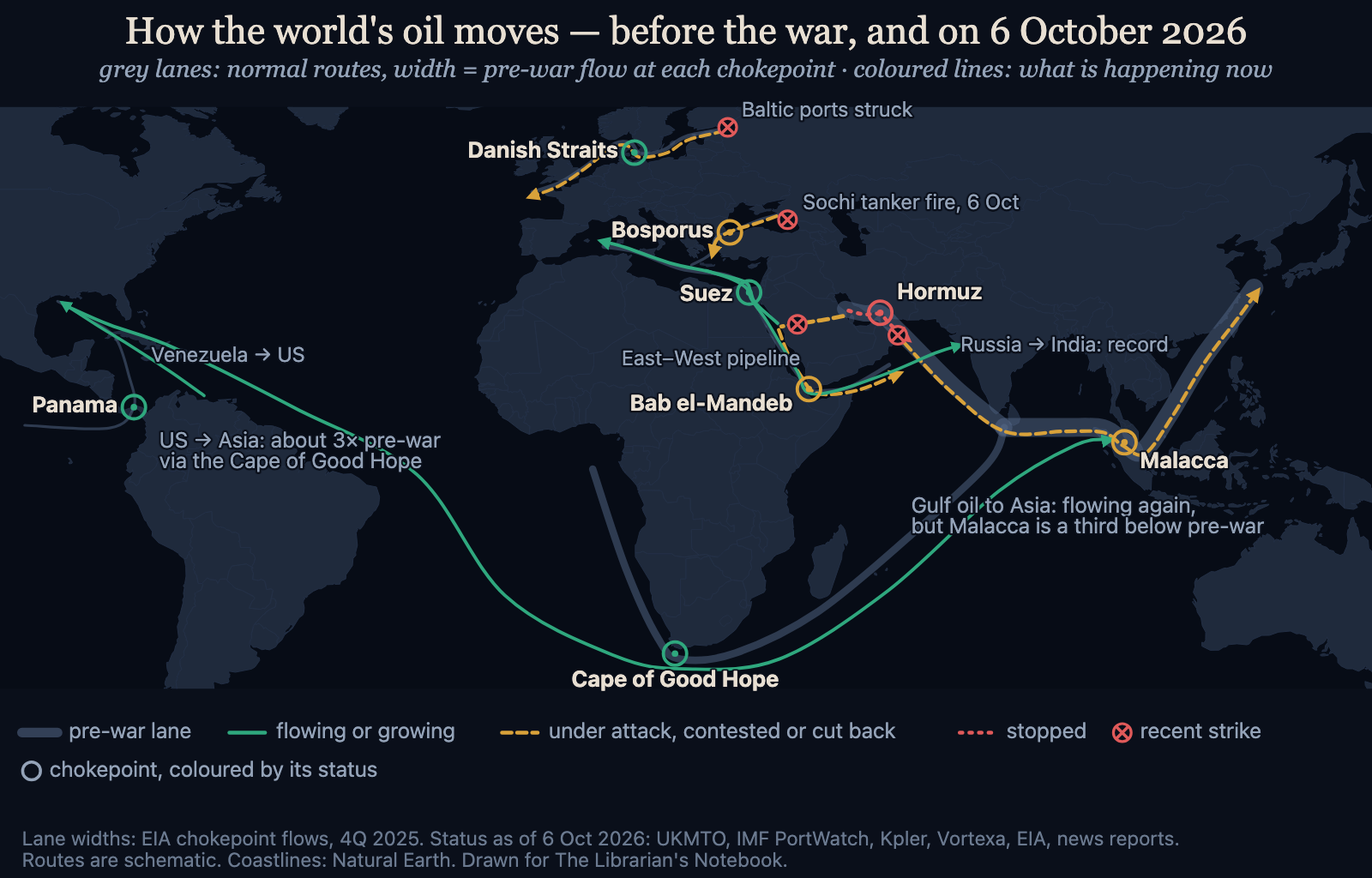
How the world's oil moves, before the war and now. Lane widths are EIA's pre-war chokepoint flows (fourth quarter of 2025); status lines as of 6 October 2026. Coastlines from Natural Earth. Drawn for this page.
This is a living page. Since September I've written eight pieces about the oil war, each a snapshot of one moment: a pipeline, a strait, a rationed box of motor oil, and on the Ledger the Fed, diesel, inventories and the futures market. Rather than stack an eighth on top, this page holds the whole picture and gets rewritten as it changes. Last updated October 10, 2026.
For seven months the headline has been "Hormuz closed." The oil has stopped waiting for it to reopen. In the last week of September, Middle East crude exports were back at or above their pre-war level on several days. They went round the strait by pipeline, or through it on small tankers with their transponders off, while somebody fired at the tankers about once a day. So oil is still near $100, the world's stockpiles are thinner than they have been in years, and the routing has never looked stranger. The map above is that routing. Everything below it explains one piece.
The briefing at a glance
Live briefing · updated Oct 10, 2026
The oil is flowing again. By detour, and under fire.
Gulf crude exports are back around their pre-war level, but the Strait of Hormuz is still shut to normal traffic, tanker attacks reached a wartime high in early October, and oil costs 44% more than it did in February.
Hormuz: shut to normal traffic · Gulf exports: near pre-war, Oct data softer · Red Sea exit: contested · Black Sea: strikes continue · US Gulf: hurricane shut-ins
18.3m b/d Middle East crude exports, 7-day average on Sep 30 (Kpler), against about 18 before the war. Provisional early-October data reportedly run lower.
4/ 85 ships through Hormuz on Oct 4, against a pre-war 85 a day (IMF PortWatch’s latest weekly count). Most of what moves now runs dark.
~40% of Middle East oil exports now avoid the strait altogether, mostly by Saudi pipeline to the Red Sea (Al Jazeera)
$105 Brent settled at $104.72 on Oct 9, against $72.48 the day before the war: +44%
~3bn bbl of supply lost from the region since February, says Aramco's CEO; over 1 billion drawn from reserves to cover it
1/30 the G7's 100-million-barrel emergency release, set against that 3-billion-barrel hole
Why oil is over $100 when the oil is flowing
Flows have recovered; prices have not. Three reasons, roughly in order of size.
The hole already dug
Seven months of lost supply came out of the world's stockpiles. Aramco's CEO says nearly 3 billion barrels were lost and over 1 billion drawn from reserves, and refilling them while still meeting demand could take up to two years. Exports back at 100% only stop the hole getting deeper. More on the inventory numbers →
The price of the detour
Every barrel now travels further or more dangerously: a 1,200 km pipeline, a ship-to-ship transfer in the Gulf of Oman reportedly at capacity, war-risk insurance, and captains reportedly paid $100,000 a month to run the strait. Gulf News puts the logistical constraints at the heart of the gap.
The flow is fragile
The detour works only while nobody hits it. UKMTO counted nine tanker attacks in Hormuz by Oct 7, the worst stretch of the war, and they have spread to the waters off Qatar and the UAE. The pipeline was knocked out by drones in September, and the Red Sea exit is still being fought over. "Sustainable unless attacks on ships or on the pipeline resume," as one analyst put it, which is not much of an unless.
Brent futures (oil for later delivery, Oct 6): $100.58
Brent spot (a physical cargo now, Oct 6): $100.58+$25
The chokepoints, before and now
Hormuz: 21.6 → 4.9
Malacca: 24.9 → 16.6
Cape of Good Hope: 9.9 → 9.4
Bab el-Mandeb: 5.4 → 8.1
Suez + SUMED: 5.9 → 5.8
Danish Straits: 5.0 → 4.7
Turkish Straits: 3.7 → 4.1
Panama: 2.8 → 3.2
The two zooms
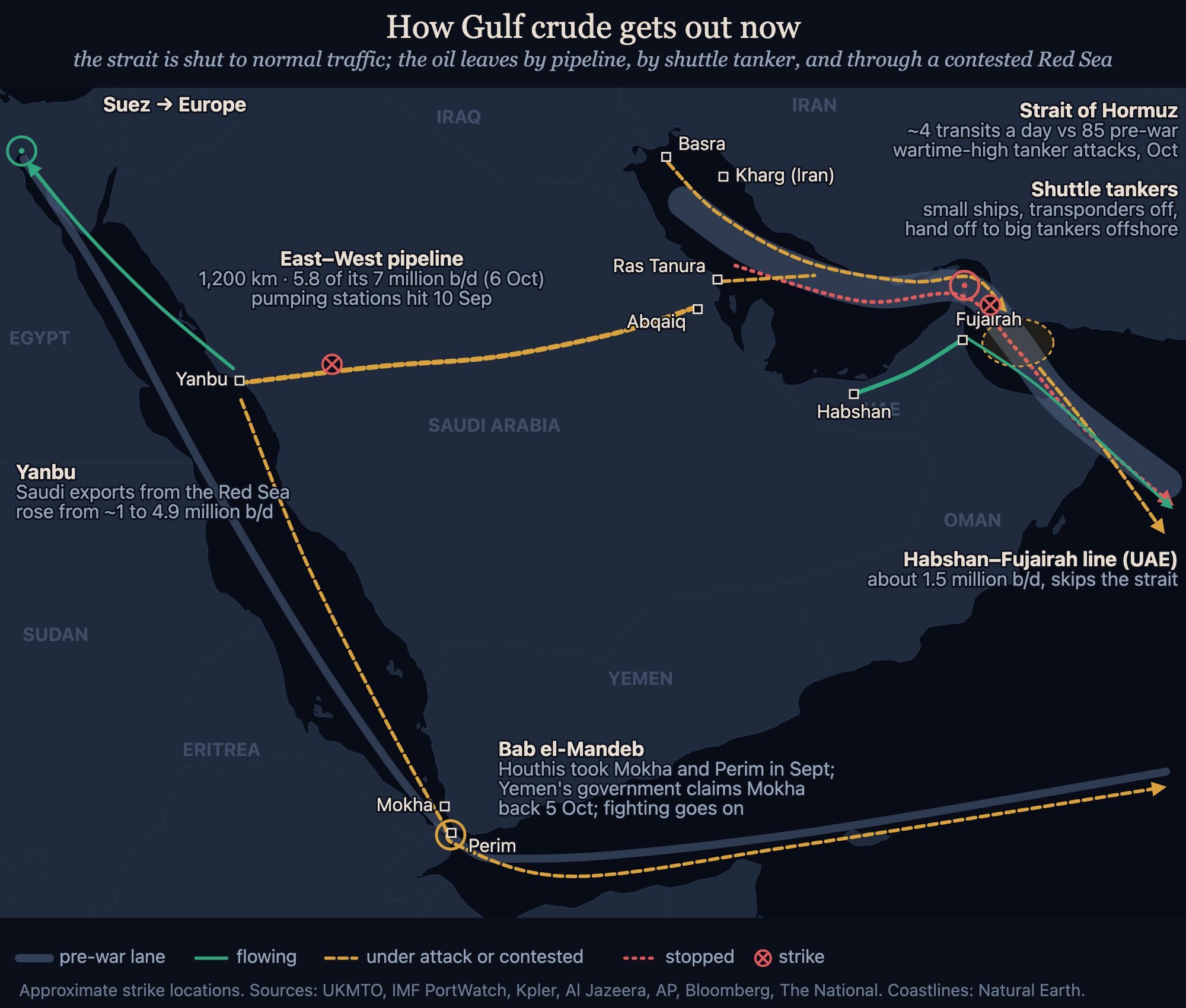
The Gulf. The strait is shut to normal shipping, so the oil leaves three other ways: across Saudi Arabia by pipeline, through the UAE's line to Fujairah, or through the strait on small shuttle tank…
The Gulf. The strait is shut to normal shipping, so the oil leaves three other ways: across Saudi Arabia by pipeline, through the UAE's line to Fujairah, or through the strait on small shuttle tankers that hand off to big ones in the Gulf of Oman. Strike positions are approximate.
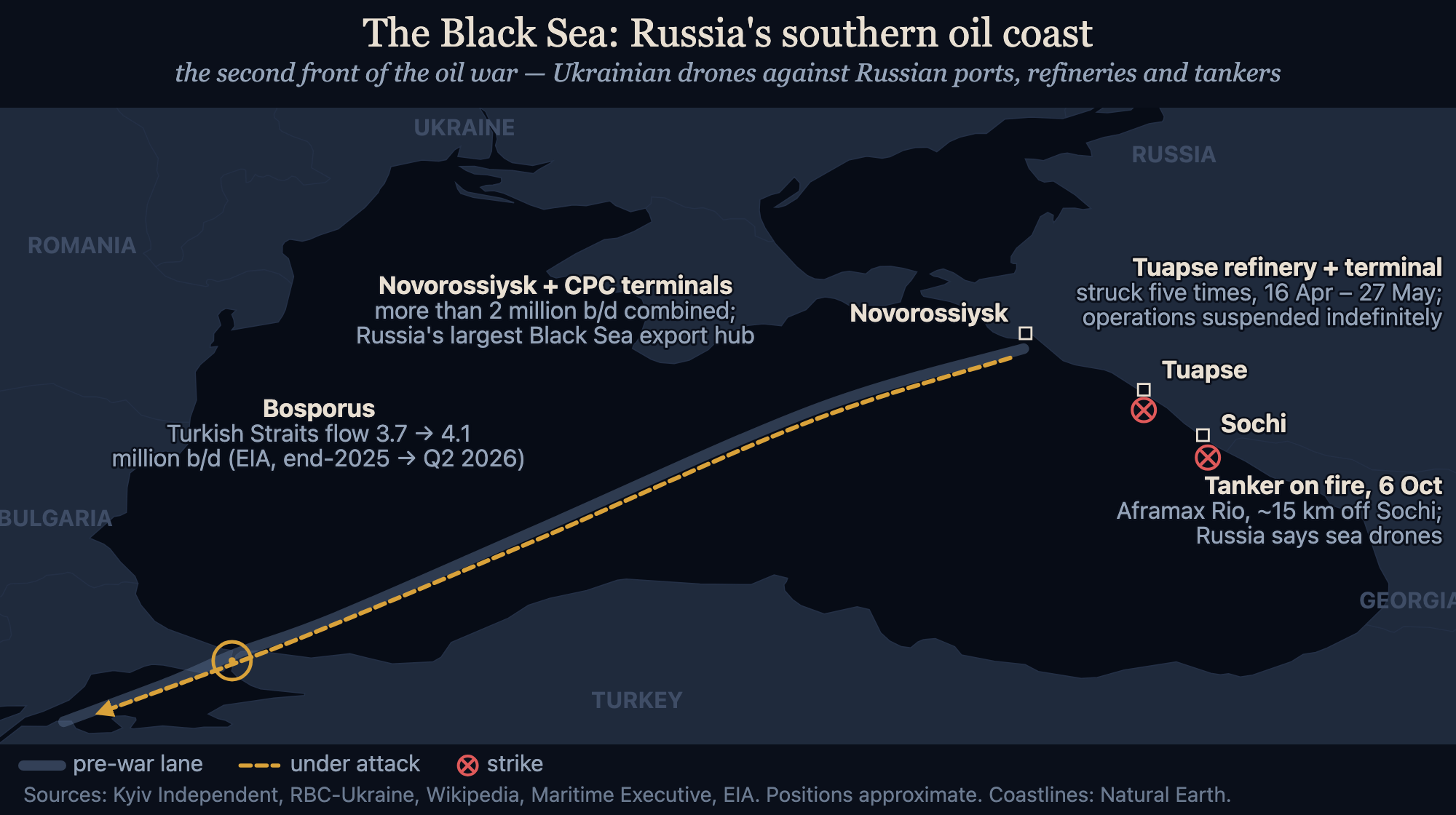
The Black Sea, the second front. Ukraine's long-range campaign against Russian oil infrastructure has hit refineries, terminals and tankers; the Sochi fire is the newest entry. Russia says sea dron…
The Black Sea, the second front. Ukraine's long-range campaign against Russian oil infrastructure has hit refineries, terminals and tankers; the Sochi fire is the newest entry. Russia says sea drones did it, and Kyiv hasn’t clearly claimed it.
From a strait to a shelf
1 · Crude · Supply. Brent near $105. In its September report the IEA expected world oil supply to shrink by 5.7 million b/d this year and demand to fall by 2.5 million b/d; the October report is due Oct 14. OPEC+ left its targets unchanged on Oct 4, which matters little while the Gulf can’t ship its quota.
2 · Refineries · Fuels. The IEA says the demand losses fall hardest on middle distillates, which means diesel. A reported US diesel export ban would have shrunk gasoline too; the White House now says none is coming.
3 · Prices · Inflation. August US inflation was 3.4%, but 2.4% without energy. On Sep 16 the Fed raised rates anyway, to 3.75–4%, its first hike since 2023. September’s inflation figure comes out Oct 14.
4 · Shelf · Rationing. Costco began limiting motor oil in September, a first in its history. And not only oil: about 20% of LNG and up to 30% of traded fertilizer normally pass Hormuz.
Timeline
Feb 28 · Well reported — US and Israeli strikes on Iran; the war begins (Brent the day before: $72.48.)
Mar 1 – 4 · Well reported — Iran's Revolutionary Guard declares the Strait of Hormuz closed; ship attacks begin
Mar 31 · Well reported — Brent closes at $118.35, the war's peak close (The intraday high in March was reported at $126.)
Apr 16 – May 27 · Well reported — Ukrainian drones strike Russia's Tuapse refinery and terminal five times; operations suspended
May 4 – 6 · Well reported — "Project Freedom" US Navy escort mission launched, then paused
Jun 17 · Well reported — Islamabad Memorandum signed; Iran says the closure resumed three days later
Jul 1 · Well reported — Brent bottoms at $71.57, back at its pre-war price
Jul 8 · Well reported — The interim truce breaks down after Iran strikes commercial ships
Aug 25 · Well reported — US Navy says it has cleared more than 100 suspected mines
Early Sep · Well reported — Houthis take Mokha and Perim island at Bab el-Mandeb (The Other Door, Sep 12.)
Sep 10 · Well reported — Drones hit pumping stations on Saudi Arabia's East–West pipeline (The Escape Valve, Sep 11.)
Sep 24 – 29 · Well reported — Middle East crude exports exceed pre-war levels on four of seven days (Up to 22.5 million b/d on peak days, per Reuters citing Kpler.)
Oct 1 · Reported, details vary — The supertanker Kazimah III is struck by a projectile and catches fire
Oct 3 – 5 · Reported, details vary — Houthis claim missile and drone strikes on Aramco sites in Riyadh and Khurais; smoke seen at both (Reuters had a witness to a large fire near an Aramco facility in Riyadh on Oct 3; the coalition called the Houthi claims "misleading." Satellite imagery shows smoke at Khurais on Oct 4 and 5 but not the cause or damage (Al Jazeera, Misbar, Türkiye Today). Khurais sits on the East–West pipeline.)
Oct 2 · Reported, details vary — Two more tankers are hit by unidentified projectiles near Hormuz (A Panama-flagged tanker caught fire and lost power but kept moving toward Fujairah; a crude tanker about 4 nm east of Oman was struck hours later. No casualties reported. Per UKMTO, as relayed by Seatrade and the Manila Times.)
Oct 4 · Reported, details vary — The tanker Lipsi takes a hit to its engine room; Iran's parliament speaker says the strait stays shut until the US meets seven conditions
Oct 4 · Well reported — OPEC+ keeps November production targets unchanged (Seven core members, meeting online; next meeting November 1. Gulf members are pumping well below quota because they can’t export it. The UAE is no longer in the group: it left OPEC and OPEC+ on May 1.)
Oct 5 · Claimed or disputed — Yemen's government says its forces have retaken Mokha and secured Bab el-Mandeb (Claimed, with Saudi-led air support; the Houthis responded with strikes on southern Saudi Arabia. Not independently confirmed.)
Oct 5 · Well reported — Aramco's CEO calls the world's stockpiles "scarily thin"
Oct 6 · Reported, details vary — Physical crude trades about $31 above futures, near April's record (Dated Brent against ICE Brent futures, per a Bloomberg chart shared on X. The EIA’s own spot series puts the gap at about $25 that day and $33 on Oct 2. The low this year was below zero, on July 13.)
Oct 5 · Reported, details vary — A drone strike sinks the grain ship Royad Mammadov off Romania (Two sailors killed, one missing, 11 rescued. Ukraine's president blamed two Russian drones; the ship was carrying Ukrainian grain in Romania's exclusive economic zone. Per Euronews.)
Oct 6 · Reported, details vary — A tanker, the Aframax Rio, burns about 15 km off Sochi (Russia’s Transport Ministry says uncrewed boats attacked it; all 23 crew were evacuated. It was reportedly carrying crude from Novorossiysk to India. Ukraine has not clearly claimed it. Greenpeace saw a slick of about 25 km² on satellite images on Oct 8, while Russia’s consumer watchdog said there was no pollution. The ship is on Ukraine's shadow-fleet sanctions list.)
Oct 6 · Well reported — The largest oil depot in the Moscow region burns after an overnight drone raid (The Volodarskaya station, which handles about 3 million tonnes of fuel a year and supplies jet fuel to Moscow's airports. Reported by Meduza, Euromaidan Press and others.)
Oct 6 · Claimed or disputed — A fire at the Rabigh refinery on Saudi Arabia's Red Sea coast, after a Houthi claim (The Houthis claimed a "precise and direct" strike on the Aramco refinery and on Riyadh's airport; Saudi Arabia condemned the strikes. A large fire is visible on satellite data. The attribution is the Houthis' own claim.)
Oct 6 · Well reported — Saudi Arabia says the East–West pipeline is back to 5.8 million b/d (The energy minister, at a forum in Bahrain: “as of this morning we’re back up to 5.8 million barrels.” Its capacity is 7 million. Kpler had it at about 2 million in August.)
Oct 7 · Well reported — US crude stocks fall 3.2 million barrels; the strategic reserve drops another 784,000 (EIA weekly data: a draw where a build of about 1.9 million was expected. The reserve is at about 283 million barrels, which the ZeroHedge post describes as 13 million above its record low.)
Oct 7 · Reported, details vary — France and Germany say their share of the G7 diesel release may add no new barrels (Politico, as relayed by Walter Bloomberg on X and Peter Theil: the stocks come largely from reserves already committed in March. Germany plans no new release; France could add about 2 million barrels but has made no firm pledge. An emergency IEA meeting on the coordinated release was said to be scheduled for today.)
Oct 7 · Reported, details vary — UKMTO counts nine tanker attacks in Hormuz so far in October (Already half of September’s total for the strait and the Gulf combined. Reuters and CNBC both describe the week to October 4 as the worst for tanker attacks since the war began, with transits at their lowest in more than two months.)
Oct 8 · Reported, details vary — A tanker is hit by several projectiles off Qatar’s north coast; casualties reported (About 94 km north of Madinat ash Shamal, inside Qatar’s exclusive economic zone, per UKMTO. Numbers of dead or injured not given; Qatar has not commented (Al Jazeera).)
Oct 8 · Well reported — Trump says the US will not resume strikes on Iran before the November 3 midterms (Iran’s foreign minister says Tehran is reviewing the US response to its “seven-day plan” to reopen the strait and will answer “within a few days.” No agreement.)
Oct 7 – 9 · Well reported — Hurricane Isaias shuts in about 72% of US Gulf of Mexico oil output (Roughly 1.5 million b/d by Friday, up from 25% on Wednesday and 63% on Thursday, per US offshore regulator figures reported by Reuters. Refineries on the Mississippi–Alabama coast were the bigger worry, with landfall expected overnight into Saturday.)
Oct 9 · Well reported — Brent settles at $104.72, up 4.5% from Wednesday (Up 4% on Thursday to $104.28, then a little more on Friday as the hurricane shut-ins grew; WTI $91.85. Brent is 44% above its pre-war close.)
Oct 9 – 10 · Reported, details vary — A tanker burns off the UAE; the National Guard rescues all 22 crew (The UAE statement names neither the ship nor the cause. UKMTO logged a projectile strike and a fire, since put out, off the UAE coast on Friday, and shipping sources name the Panama-flagged crude tanker GEM NO.2 (Middle East Online). The link between the two is reported, not official.)
Oct 10 · Well reported — A strike on Riyadh’s airport kills 12, including an American, and wounds more than 300 (The third strike on King Khalid International this week. The US State Department blames the Houthis; Trump says he is weighing whether the US should join Saudi strikes on them. Not an oil target, but the same war that has been hitting Aramco sites since October 3.)
Oct 10 · Reported, details vary — A tanker leaving Hormuz is struck by a projectile and catches fire; Iran says a tanker hit a mine (UKMTO: an outbound tanker was hit on its port side by an unknown projectile, starting a fire; the crew is safe, and damage is unknown. The IRGC, via Tasnim, says an unnamed tanker exploded and burned after striking a naval mine in the strait. Nobody has said whether these are the same ship.)
Oct 10 · Well reported — The US disables a ship running the blockade of Iran (CENTCOM says a fighter jet hit the stern of the Panama-flagged Ocean Molica in the Gulf of Oman after it left an Iranian port and ignored warnings. It counts four commercial ships disabled and 135 turned back in three months. Separately, UKMTO says ships anchored off Ras Al Khaimah were ordered by radio to leave; no reason given.)
Oct 10 · Claimed or disputed — Fighting still “raging” around Mokha and Dhubab at Bab el-Mandeb (Five days after the government said it had taken both, it says its forces are still advancing (Al Jazeera). The Houthis deny losing Mokha. Its casualty claims against the Houthis can’t be verified.)
Claim check
"The Strait of Hormuz is closed" (Shut to normal traffic (~4 transits a day vs 85), but oil still leaves through it on shuttle tankers) · Partly true
Gulf crude exports are back above pre-war levels (Kpler and Vortexa both put late-September averages at 18.3–18.6m b/d, against about 18) · Confirmed
Captains are paid $100,000 a month to run the strait (Financial Times, as relayed by straits.live; I could not open the original) · Reported
Yemen's government retook Bab el-Mandeb (Government and Saudi-led coalition claim, Oct 5. On Oct 10 the same forces were still fighting around Mokha and Dhubab, and the Houthis deny losing Mokha) · Contested
"Ukraine has just struck an oil tanker off Sochi" (A widely shared X post, Oct 6. Russia’s Transport Ministry now says uncrewed boats attacked the Aframax Rio, which points to Ukraine, but Kyiv hasn’t clearly claimed it) · Likely, unclaimed
Venezuela's second-largest refinery, Cardón (310,000 b/d), caught fire and shut down (PDVSA says a ruptured gas pipeline to the boilers started a fire that was quickly contained, with no injuries or serious damage; Arab News and Al Jazeera report the shutdown. A video of the fire was first shared on X on Oct 6. Argus separately reports repeated fires at El Palito this year) · Confirmed
Five oil sites were hit in 24 hours (Cardón, a Moscow-region depot, the Sochi tanker, Rabigh, more Hormuz tankers) (A Vonbury Research summary on X, Oct 6. Each incident has separate reporting, but the Rabigh attacker is a Houthi claim and the Sochi cause is unconfirmed) · Mostly confirmed
Yemeni missiles hit Aramco facilities in Jeddah; the night sky is orange (RT video, Oct 6, 22:01 UTC, attributed to NAYA footage. I found no confirmation from Saudi authorities, Aramco or a wire service for Jeddah tonight. Riyadh and Khurais strikes since Oct 3 are better reported) · Unconfirmed
Buyers who need oil now pay over $30 a barrel extra (A Bloomberg chart shared by Karel Mercx, Oct 6. The EIA’s spot series agrees on the size but not the exact day: about $33 on Oct 2, about $25 on Oct 5 and 6) · Roughly right
Freight from West Africa to China jumped 17.6% in a day, to $27.22 a barrel (Karel Mercx on X, Oct 3; I could not find the underlying freight assessment) · Single source
"Under 6 billion barrels remain" (A real quote from Aramco's CEO, about commercial inventories; not the same measure as the 6.8 billion "floor" it went viral beside) · Real, often misread
The US is banning diesel exports for 90 days (Reported by Politico Sep 23; the White House has since denied a ban is coming, and none has been signed) · Denied
The G7's 100-million-barrel diesel release is mostly new supply (Doubtful for the European share: France and Germany say theirs will largely come from reserves already committed in March (Politico, relayed Oct 7). I have not seen the Politico article itself; the reporting reaches me second-hand) · Disputed
“An oil tanker exploded after hitting a naval mine in the Strait of Hormuz” (Oct 10) (The IRGC’s account via Tasnim, with no ship named. UKMTO’s report the same day describes a projectile strike and a fire. Iranian outlets have said the same kind of thing before: on October 3, state TV said a tanker exploded after switching off its tracker, and CENTCOM disputed a September mine claim about the El Gaia) · Claimed
Hormuz flows fell back to 8.5m b/d in the week to Oct 7, and Middle East exports to 15.3m, 10% below pre-war (CNBC citing Kpler, Oct 9; I could not open the article. A separate post citing Kpler puts the Gulf total just under 15m b/d in early October, says it leaves out Red Sea loadings, and notes the latest two weeks are provisional and likely to be revised up) · Reported, provisional
What would change the picture
The attack tempo in Hormuz The first week of October brought the most tanker attacks of the war, and they have since reached the waters off Qatar and the UAE. A hit that sinks a shuttle tanker or closes the transfer area would put the recovery straight back to zero. · Rising
The East–West pipeline It carries roughly a quarter of the region's exports by itself, and Saudi Arabia says it was back to 5.8 million b/d on Oct 6, out of 7 million capacity. The September drone strike stopped it for days, not months; a trunk-line rupture would be months. Houthi strikes near Khurais, on its route, are the risk to watch. · Running, 5.8m b/d
Who holds Bab el-Mandeb The government said on Oct 5 it had taken the strait; on Oct 10 its forces were still fighting for Mokha and Dhubab. If it holds, Yanbu's southern exit reopens to Asia. If the Houthis keep it, the bypass loses its door. · Contested
Inventories, not flows The IEA’s next monthly report is due October 14 and will show whether stocks are still falling. The EIA estimates world inventories fell 1.9 million b/d in the third quarter. Price follows the hole, not the daily flow. · Monthly reports
The story so far, on this site
The Escape Valve: The East–West pipeline hit; how much oil wasn't flowing (Sep 11 · Notebook)
Icons and maps drawn for this page. Status labels are my reading of the sources listed below, not an official classification, and they change as the story does. The written detail behind every box follows.
The full write-up
The graphic above is the summary. Below is the detail, with who said what.
The week since: October 7 to 10
Attacks became more frequent. UKMTO said on October 7 that there had already been nine attacks on tankers in the Strait of Hormuz that month, half of September's total for the strait and the Gulf combined. Reuters and CNBC both call the week to October 4 the worst of the war for tanker strikes. The attacks are also moving deeper into the Gulf. On October 8 a tanker was hit by several projectiles about 94 km off Qatar's north coast, and UKMTO reported casualties without giving a number. On Friday a tanker off the UAE was struck and caught fire, and on Saturday the UAE National Guard said it had rescued all 22 crew from a burning tanker in Gulf waters. Shipping sources name the ship as the Panama-flagged GEM NO.2; the UAE statement named neither the ship nor the cause.
Then on Saturday came the explosion in the strait itself. UKMTO reported that an outbound tanker had been hit on its port side by an unknown projectile and caught fire; the crew is safe and the damage not yet known. The IRGC's version, carried by Tasnim, is that an unnamed tanker exploded and burned after hitting a naval mine. These may be the same ship or two different ones, and nobody has said which. I'd weigh the IRGC account against its record. Iranian outlets have made the same kind of claim at least twice before: on October 3, and in September, when CENTCOM said the damage had come from an Iranian missile and drone, not a mine. The same evening CENTCOM said a US jet had disabled the Panama-flagged Ocean Molica in the Gulf of Oman as it tried to run the blockade of Iranian ports, and ships anchored off Ras Al Khaimah were told by radio to leave.
Whether the attacks are starting to cost barrels is the open question. CNBC, citing Kpler, reported on October 9 that flows through Hormuz fell back to 8.5 million barrels a day in the week to October 7 and that Middle East exports as a whole were 15.3 million, about 10% below pre-war. I could not open that article. Another post citing Kpler puts the Gulf total just under 15 million in early October. That series leaves out Red Sea loadings from Yanbu, and Kpler says its last two weeks of data are provisional and likely to be revised up. So the September recovery may be slipping, or the data may again be lagging behind the ships that sail with their transponders off. The tile above keeps the September 30 figure until a firmer number replaces it.
Talks are stalled but still going. Iran's foreign minister said on October 8 that Tehran was reviewing the US response to its "seven-day plan" for reopening the strait and would reply "within a few days." The US counter-offer, reported on October 7, would reopen the strait after seven days in exchange for lifting the blockade and sanctions, with nuclear talks to follow. On October 8, Trump also said the US would not resume strikes on Iran before the November 3 midterms. In Saudi Arabia, a strike on Riyadh's King Khalid International Airport on October 10, the third there this week, killed 12 people, including an American, and wounded more than 300. The State Department blamed the Houthis, and Trump said he was weighing whether the US should join Saudi strikes on them. The airport is not an oil target. But it is the same campaign that has been hitting Aramco sites since October 3, and US involvement would change the risk to the Red Sea bypass, for better or worse.
Where things stood on October 6
The Strait of Hormuz is still shut to ordinary shipping. IMF PortWatch counted four transits on October 4, against a pre-war baseline of 85 a day, and about 195 ships were holding position on either side of the strait. Iran's parliament speaker said on October 4 that it cannot reopen until the United States meets seven conditions from the June agreement. UK Maritime Trade Operations has reported at least one attack a day since October 2, including the supertanker Kazimah III, set on fire by a projectile on October 1, and the tanker Lipsi, hit in the engine room on October 4.
And yet the oil is getting out. Kpler put the seven-day average of Middle East crude exports at 18.3 million barrels a day on September 30, and Vortexa's 14-day average was 18.6, both against roughly 18 million in the year before the war. Exports beat the pre-war level on 14 days in September. About 40% of the region's exports now avoid the strait entirely, mostly through Saudi Arabia's East–West pipeline to Yanbu on the Red Sea, where loadings went from about 1 million to 4.9 million barrels a day. Most of the rest goes through the strait on small shuttle tankers, often with their transponders switched off, which hand their cargo to large tankers in the Gulf of Oman. "The shuttle system in the Gulf is doing wonders in getting oil out, but it requires plenty of ships," as one analyst told Al Jazeera. That is also why the PortWatch count and the export figures don't contradict each other: a ship that turns its transponder off doesn't get counted.
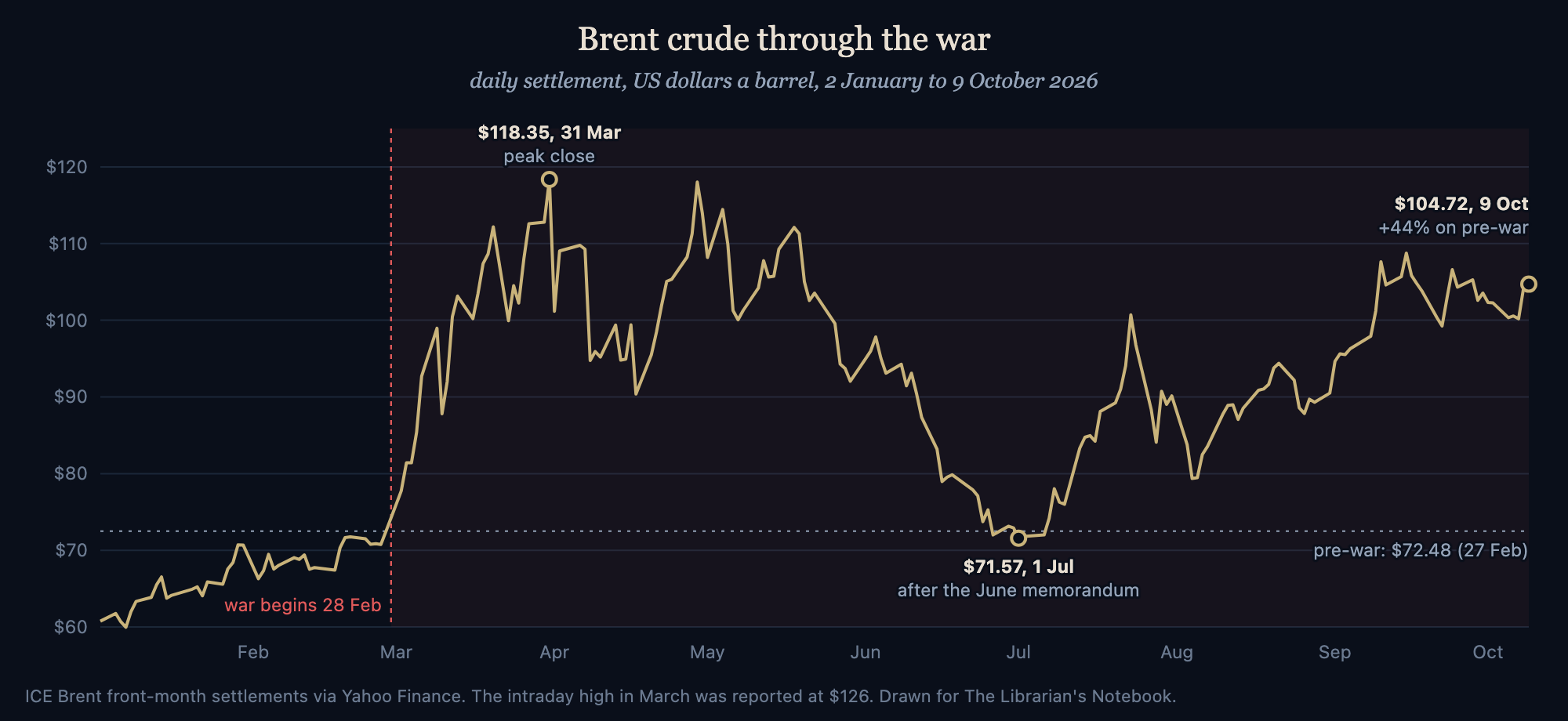
Brent settled at $104.72 on October 9, 44% above its $72.48 close the day before the war. It jumped 4% on October 8 and gained a little more the next day as a hurricane shut in US Gulf of Mexico output. It has already made one round trip: up to $118.35 at the end of March, back down to $71.57 on July 1 after the June memorandum, and up again once the truce broke down a week later. The EIA’s October outlook expects Brent to average $105 in the fourth quarter. It assumes Middle East flows stay constrained, with 4.5 million barrels a day still shut in, and has the price easing to $87 by the second quarter of 2027.
What I had wrong a month ago
On September 11, in The Escape Valve, I wrote that Gulf crude exports had fallen from about 17 to about 9 million barrels a day and that the strait was effectively closed. Both were right that week. The first is not right now. Exports recovered over September, and Hormuz turned out to be closed to normal shipping rather than to oil. I've added a note to that entry pointing here, rather than rewriting it, because it was an accurate picture of its day and the change is the story.
Why the price hasn't followed the flow
Because the flow was never the whole problem. Aramco's chief executive, Amin Nasser, said in London on October 5 that the war had cut supply from the region by "nearly three billion barrels," that more than a billion had been drawn from reserves to cushion it, and that "replenishing inventories while meeting demand could take up to two years." The IEA's own count of observed stock draws since February was 507 million barrels through August. That is a different measure (what came out of tanks the IEA can see, not what was never produced), and the Ledger entry on his speech goes through why the definitions matter. On either measure, the G7's plan to release 100 million barrels over four months is small against the hole.
The $100 is also flattering. It is the price of a Brent futures contract, oil for delivery in a month or two. A refinery that needs a cargo now buys physical crude, priced off Dated Brent, and the gap between the two is the market's own measure of how scarce oil is today. The EIA wrote in April that the physical premium had passed $25 a barrel, because "the scramble by buyers to secure volumes to replace obstructed shipments that would have come through the strait is better represented in spot market prices than in futures contracts." By mid-July, during the truce, the gap had turned slightly negative. On October 6 a Bloomberg chart shared by the analyst Karel Mercx put it back at about $31, just short of April's peak. The EIA’s own daily Brent spot series, which runs a few days behind, roughly agrees: $135.51 on October 2 against a futures settlement of $102.25, a gap of about $33, and about $25 on October 5 and 6.
The detour also costs money. Freight is up, tankers are scarce worldwide because so many are tied up on longer voyages or in the shuttle relay, and war-risk insurance is priced for a war. Mercx also reported on October 3 that the cost of shipping a 2-million-barrel cargo from West Africa to China jumped 17.6% in a single day, to $27.22 a barrel; I could not find the freight assessment behind that number. Gulf News, relaying Reuters, said prices remain about 40% above pre-war "largely because of logistical constraints."
And it is fragile. "The flow will be sustainable unless attacks on ships, or on the pipeline, resume, something that does not seem imminent at the moment but could happen at any time," analyst Tamas Varga told Al Jazeera. Attacks on ships have, in fact, resumed.
The chokepoints, by the numbers
The EIA's August chokepoint update compares the last quarter of 2025 with the second quarter of 2026. Hormuz fell from 21.6 to 4.9 million barrels a day. The Strait of Malacca, where Gulf oil reaches China, Japan and Korea, fell from 24.9 to 16.6. Bab el-Mandeb rose from 5.4 to 8.1, which is the Saudi bypass at work: oil piped across the peninsula and shipped south out of the Red Sea. The Turkish Straits rose from 3.7 to 4.1 and Panama from 2.8 to 3.2; Suez, the Cape of Good Hope and the Danish Straits barely moved. World oil supply fell from 103.9 to 99.7 million barrels a day over the same two quarters. The September recovery is not in these numbers yet.
The Red Sea door
The bypass has a weak point at the bottom: Bab el-Mandeb, the strait between Yemen and Djibouti that Yanbu's tankers must pass to reach Asia. In early September the Houthis took the port of Mokha and Perim island in the strait itself, which I wrote about at the time (and explained at more length here). On October 5, Yemen's internationally recognized government said its forces, with round-the-clock Saudi-led air support, had retaken Mokha and the Dhubab area and secured the strait. The Houthis said they hit targets across southern Saudi Arabia in response. I'm treating the government's claim as a claim until it holds for a while, and it hasn't yet: on October 10 Al Jazeera reported battles still raging around Mokha and Dhubab, with the government saying its forces were advancing and the Houthis denying they had lost Mokha. The map shows the route as contested. The fighting has also reached Saudi territory on the same coast: on October 6 the Houthis claimed a strike on the Aramco refinery at Rabigh, and a large fire was visible there on satellite data. The fire looks real; who caused it is, for now, the Houthis' word.
The pipeline itself is also under fire. Since October 3 the Houthis have claimed ballistic-missile and drone strikes on Aramco facilities in Riyadh and at Khurais, the processing site the East–West pipeline runs through on its way to Yanbu. Reuters had a witness to a large fire near an Aramco facility in Riyadh on October 3, and satellite imagery shows smoke at Khurais on October 4 and 5, but the coalition called the Houthi claims “misleading” and the imagery shows neither the cause nor the damage; statements differ on whether pipeline flows were affected. This follows late-September Houthi claims against Yanbu (Saudi Arabia said it intercepted six missiles and saw no damage to Aramco sites) and a September wave the Saudi Energy Ministry said wounded more than 70 people and set fires at several oil facilities in the south. Tonight RT broadcast video of smoke over Jeddah, attributed to Yemeni missiles on Aramco sites; I could not confirm it. If the bypass is being hit, the Gulf export recovery on this page is less secure than the numbers suggest. So far the pipeline itself is holding: on October 6 Saudi Arabia’s energy minister said it was back to 5.8 million barrels a day, out of a capacity of 7 million, and that it had been running again within “five or six days” of the September attack.
The second front: the Black Sea
Separately from the Gulf, Ukraine has for more than a year struck Russian oil infrastructure as part of its defence against Russia's invasion: refineries, export terminals, and tankers in Russia's so-called shadow fleet. Between April 16 and May 27 its drones hit the Tuapse refinery and oil terminal five times, and operations there were suspended; I have not found a report that they restarted. Novorossiysk, Russia's largest Black Sea export hub, and the neighbouring Caspian Pipeline Consortium terminal together handle more than 2 million barrels a day and have been struck before. Russia's Baltic oil port at Primorsk was hit in March and again in May, and Ust-Luga has been targeted too.
On October 6 a tanker caught fire about 15 km off Sochi. It has been identified as the Liberia-flagged Aframax Rio, which Ukraine added to its sanctions list of shadow-fleet vessels on February 12. Video shows a large fire spreading across the water around the ship. Russia’s Transport Ministry has since said uncrewed boats attacked it, and all 23 crew were evacuated; it was reportedly carrying crude from Novorossiysk to India. Greenpeace spotted a slick of about 25 square kilometres on satellite images on October 8, although Russia’s consumer watchdog said there was no pollution. The post that brought it to my attention said flatly that Ukraine struck it. Sea drones point that way, but as far as I can find, Kyiv hasn’t clearly claimed this one.
Ships that are not oil tankers are being hit there too. On October 5 a drone strike sank the Royad Mammadov, a Turkish-owned grain ship, in Romania's exclusive economic zone; two sailors were killed and one is missing. Ukraine's president blamed two Russian drones. Both sides are now striking merchant shipping in the same sea. The campaign also reached the capital region on October 6, when the Volodarskaya oil depot, the largest in the Moscow region, caught fire after an overnight drone raid.
The Black Sea matters to the global picture less for its volume than for its direction. Russia has been one of the war's beneficiaries, selling record volumes to India while Gulf barrels were stuck, and the Turkish Straits carried more oil in the second quarter than before the war. Strikes on Russia's export coast are the one pressure on that route.
Where OPEC+ fits
Not much, for now. On October 4 the seven core OPEC+ members (Saudi Arabia, Russia, Iraq, Kuwait, Kazakhstan, Algeria and Oman) held a short online meeting and kept their November production targets unchanged, as they had for October at the September 6 meeting. They still have about 2 million barrels a day of cuts in place on paper. In practice the Gulf members are pumping well below their quotas, because they can’t ship it out: the seven produced about 25 million barrels a day in August, roughly 5 million below February, and exports have been running at 60 to 80% of normal. "OPEC+ currently has very limited power over the physical oil market," as Jorge Leon of Rystad Energy put it. The UAE is no longer part of it. It left OPEC and OPEC+ on May 1, after 59 years, mainly over quotas that capped its expanded capacity. The next meeting is November 1. The decision that matters, new production baselines for 2027, depends on a review of each member’s capacity that the war has delayed.
Downstream
A crude shortage reaches people as a fuel shortage, and this one has reached them as diesel. The IEA's September report cut its 2026 demand forecast to a fall of 2.5 million barrels a day, with the losses concentrated in middle distillates and petrochemical feedstocks, especially in Asia; it expects total supply to shrink by 5.7 million barrels a day this year. In the US, Politico reported on September 23 that the White House was preparing a 90-day diesel export ban; the Ledger looked at why that would also have cut gasoline supply. The White House has since denied a ban is coming, and none has been signed. The US inflation reading published on September 11 was 3.4%, but 2.4% without energy; five days later the Fed raised rates a quarter point to 3.75–4%, its first increase since 2023, and the September figure, due October 14, is forecast higher still. That same week Costco began rationing motor oil for the first time. Oil is not the only cargo: about a fifth of the world's LNG and up to 30% of traded fertilizer normally pass through Hormuz. LNG cargoes leaving the strait rose in September to their highest since February. The stocks side is thin too: the EIA's weekly report on October 7 showed US commercial crude down 3.2 million barrels against an expected build, and the Strategic Petroleum Reserve down another 784,000, to about 283 million. About 132.5 million barrels have left the reserve since late March under the IEA's 172-million-barrel release.
And then the weather. Hurricane Isaias, the first Atlantic hurricane of the season, forced producers to shut in about 72% of US Gulf of Mexico oil output, roughly 1.5 million barrels a day, by Friday October 9, up from 25% on Wednesday. Offshore output usually comes back within days if the platforms escape damage. The bigger risk is onshore. Chevron's Pascagoula refinery in Mississippi and the refinery at Mobile, Alabama, sat in the storm's path, and a refinery that loses power takes one to two weeks to restart even when undamaged. With US distillate stocks already low, that matters more for the diesel squeeze than for crude. I'll add what happened to those refineries once there is confirmed reporting.
The winter bill is the newest place it shows up. In its Winter Fuels Outlook, published October 6, the EIA expects households that heat with oil to spend 21% more this winter than last, the largest increase of any heating fuel, because crude and distillate prices are higher. Natural gas and propane households are forecast to pay less. Oil heat is a small slice of the country (about 3% of households, mostly in the Northeast), but the cause is the same one behind the diesel squeeze: global refining of distillate has dropped, which raises the cost of imports and pulls US exports up, and US distillate stocks are low heading into winter. The EIA notes that a warmer Northeast forecast offsets part of the price increase, and that a strong El Niño could move temperatures well away from its assumptions.
Maine, the state most dependent on oil heat, shows what that looks like at the pump. Bloomberg reported on October 6 that heating oil there recently hit a record and now averages $5.96 a gallon, up about 80% from a year ago, which works out to roughly $1,500 to fill a standard residential tank that most homes will need to refill a few times before spring. That is a price per gallon in one state, not the EIA's national bill forecast, so the two numbers measure different things and are not directly comparable.
Where I could be wrong
Ship-tracking is the weak instrument here, and it matters more now that early-October flow data run lower than September’s. The EIA itself warns that transponder data for Hormuz has been "especially unreliable" since February, and the export recovery depends on ships that turn theirs off; Kpler and Vortexa model around that, but they are estimates. The "40% avoid the strait" figure is Al Jazeera's summary and I could not trace its original source. Strike locations on the maps are approximate, and the status colours are my reading. The Bab el-Mandeb claim and the Sochi fire are both only days old. If either changes, this page will.
Update log
October 10, later. Added the October 4 OPEC+ decision (November targets unchanged; the UAE left the group in May) as a timeline event and a short section, and went through every box for staleness. Changes: the Fed box now says the Fed raised rates on September 16 (it said "weighing a hike"); the physical-premium box now uses the EIA’s Brent spot series (about $25 over futures on October 6, $33 on October 2) instead of a single X post; the East–West pipeline card now carries Saudi Arabia’s 5.8-million-barrel figure; Bab el-Mandeb is now marked contested, because fighting around Mokha was still going on October 10; and the Sochi tanker now reflects Russia’s statement that uncrewed boats attacked it, plus the Greenpeace slick. The labels on the Gulf and Black Sea maps were updated to match. The chokepoint table is unchanged, because the EIA has not yet published third-quarter figures.
October 10. Added the week's events: the October 10 Hormuz tanker fire (UKMTO: a projectile; IRGC: a mine), the US disabling of the Ocean Molica, the October 8 tanker strike off Qatar, the GEM NO.2 fire and crew rescue off the UAE, the Riyadh airport strike, Hurricane Isaias shutting in about 72% of US Gulf output, and the stalled seven-day-plan talks. Updated Brent to the October 9 settlement ($104.72, +44%) on the tiles and the chart, and added the EIA's fourth-quarter forecast. Added two claim-check rows: the IRGC mine claim, and provisional Kpler data showing lower October flows. The Gulf-exports chip now reads "near pre-war, Oct data softer." The physical-premium box still shows its October 6 reading because I have found no newer figure.
October 6, 11 pm. Added the Houthi strikes on Aramco sites in Riyadh and Khurais (Oct 3–5) as a timeline event, a paragraph in the Red Sea section, and an unconfirmed claim-check row for tonight's RT Jeddah video.
October 7, evening. Added the Politico report (second-hand) that France and Germany expect to meet their G7 diesel pledge largely from reserves already committed in March, and a claim-check row on whether the 100-million-barrel release is new supply. I could not open the Politico article, so the details come from a post by Walter Bloomberg and a news aggregator.
October 7, afternoon. Added the October 6 Moscow-region depot fire and Rabigh refinery fire (Houthi-claimed), upgraded the Cardón refinery row to confirmed, added a claim-check row for the “five sites in 24 hours” summary, and added the October 7 EIA inventory draw. I did not update Brent: sources I found disagree on today's price, so the chart still ends at the October 5 close.
October 7. Added the October 2 Hormuz tanker strikes (two ships; eight merchant vessels struck since September 28, per UKMTO reporting) and the October 5 sinking of the grain ship Royad Mammadov in the Black Sea. One source spells the Sochi tanker “Aframax Rea”; I have kept “Rio” pending a check of ship registries.
October 6, late night. Added an unconfirmed claim-check row: a video of a Venezuelan refinery fire (RTVisual on X). Not yet reported by any outlet I could find.
October 6, night. Added Maine heating oil: $5.96 a gallon, about 80% above last year (Bloomberg, via a Joe Weisenthal post).
October 6, evening. Added the EIA Winter Fuels Outlook: heating-oil bills forecast up 21% this winter, the largest increase of any heating fuel.
October 6, later. Added the physical-versus-futures price gap (about $31 a barrel, reported) and the West Africa–China freight claim (single source).
October 6. Page created, with the world flow map, the Gulf and Black Sea zooms, EIA chokepoint figures, the Brent chart, and the Sochi tanker fire (cause unconfirmed). Supersedes the "17 to 9 million barrels a day" figure in The Escape Valve, which described mid-September.
Brent through the war: two round trips, and now a third leg up. ICE front-month settlements via Yahoo Finance.
Sources
Al Jazeera. Houthis claim strike on Saudi energy facility as Yemen fighting intensifies. 4 October 2026. aljazeera.com
Misbar. Misbar documents smoke near Khurais following Houthi attack on Aramco facility. 6 October 2026. misbar.com
Türkiye Today. Smoke reported over Riyadh after alleged Houthi strike on Aramco refinery (citing Reuters). October 2026. turkiyetoday.com
Bloomberg. Midterms 2026: Susan Collins, Troy Jackson clash over costs in Maine race. 6 October 2026. Read through Joe Weisenthal (@TheStalwart), post on X, 6 October 2026, which quotes the heating-oil passage. x.com
U.S. Energy Information Administration. Winter Fuels Outlook 2026–27 (October Short-Term Energy Outlook). 6 October 2026. eia.gov
U.S. Energy Information Administration. Energy security: world oil transit chokepoints, 2Q26 update. 12 August 2026. eia.gov
U.S. Energy Information Administration. Amid regional conflict, the Strait of Hormuz remains critical oil chokepoint. 16 June 2025. eia.gov
straits.live. Strait of Hormuz Status: October 6, 2026 (IMF PortWatch transits, UKMTO incidents, the Financial Times crew-pay report). straits.live
Iran International, relaying Reuters. Middle East crude exports exceed pre-war levels despite tanker attacks. 5 October 2026. iranintl.com
NBC News. Tanker attacks are escalating in the Strait of Hormuz, even as oil exports rise. October 2026. nbcnews.com
Al Jazeera. Hormuz ship attacks surge: Are increased oil exports sustainable? 6 October 2026. aljazeera.com
Gulf News. Oil prices fall: Brent settles at $100.32 as markets weigh higher Gulf exports, G7 supply boost. 6 October 2026. gulfnews.com
Wikipedia. 2026 Strait of Hormuz crisis (timeline). Accessed 6 October 2026. wikipedia.org
The Irish Times. Saudi Aramco boss warns world's oil stockpiles are 'scarily thin'. 5 October 2026. irishtimes.com
Argus Media. IEA sees big oil demand fall but still 2026 deficit. September 2026. argusmedia.com
The National. Yemeni forces claim control of Bab Al Mandeb strait and Mokha in major offensive against Houthis. 5 October 2026. thenationalnews.com
Bloomberg. Yemen Forces Recapture Mocha From Houthis, Eye Bab el-Mandeb Control. 5 October 2026. bloomberg.com
Al Jazeera. Houthis control key shipping route after gains along Yemen's Red Sea coast. 11 September 2026. aljazeera.com
The Kyiv Independent. Shadow fleet tanker reportedly ablaze near Russian port city Sochi. 6 October 2026. kyivindependent.com
Walter Bloomberg (@DeItaone). Post on X summarising Politico's report on the France and Germany diesel pledge, 7 October 2026. Cited for that report, which I could not open. x.com
Foreign Policy. G-7 Agrees to Release Emergency Diesel Stockpiles to Rein in High Fuel Costs. 2 October 2026. foreignpolicy.com
Meduza. Massive Ukrainian drone attack on Moscow and surrounding region kills two, sets region's largest oil depot ablaze. 6 October 2026. meduza.io
The Tribune. Saudi Arabia condemns Houthi strikes after Riyadh airport, Aramco refinery in Rabigh targeted. October 2026. tribuneindia.com
Arab News. Venezuela's Cardón refinery halted amid fire, sources say. October 2026. arabnews.com
Vonbury Research (@VonburyResearch). Post on X summarising the October 5–6 incidents, 6 October 2026. Cited only for the “five sites in 24 hours” framing. x.com
ZeroHedge (@zerohedge). Post on X with the EIA weekly inventory figures, 7 October 2026; the figures are cross-checked against investinglive's EIA report. x.com
Euronews. Turkish grain ship sinks in Black Sea after deadly drone attack. 5 October 2026. euronews.com
Seatrade Maritime. Tanker catches fire after first Hormuz attack in October. October 2026. seatrade-maritime.com
Manila Times. Oil tankers attacked in Strait of Hormuz, says UK agency. 4 October 2026. manilatimes.net
RBC-Ukraine. Massive fire breaks out on tanker off Sochi coast in Russia. 6 October 2026. newsukraine.rbc.ua
The Hormuz Letter (@HormuzLetter). Post on X, 6 October 2026. Cited only as the source of the "Ukraine struck" claim. x.com
The Maritime Executive. Ukraine Strikes Russian Targets in Multiple Black Sea Ports (Novorossiysk and CPC terminal volumes, citing Bloomberg). 24 September 2025. maritime-executive.com
U.S. Energy Information Administration. Brent crude oil spot prices surge past futures price in April. 24 April 2026. eia.gov
Karel Mercx (@KarelMercx). Post on X with a Bloomberg chart of the Dated Brent–futures spread, 6 October 2026. x.com
Karel Mercx (@KarelMercx). Post on X on West Africa–China freight, 3 October 2026. Cited only as the source of that claim. x.com
The Hill. White House denies planned 90-day diesel export ban. September 2026. thehill.com
Al Jazeera. Tanker hit by multiple projectiles off north coast of Qatar, UKMTO says. 8 October 2026. aljazeera.com
The Jerusalem Post. Oil tanker explodes after hitting naval mine in Strait of Hormuz (IRGC claim via Tasnim; UKMTO projectile report; CENTCOM on the Ocean Molica). 10 October 2026. jpost.com
The Jerusalem Post. Live updates, 10 October 2026 (Reuters items on UKMTO, the Ras Al Khaimah anchorages and Trump on the Houthis). jpost.com
Shafaq News. Oil tanker explodes in Hormuz (Iranian state TV and Mehr). 3 October 2026. shafaq.com
Al Arabiya. UAE rescues 22 crew members after oil tanker catches fire in Gulf. 10 October 2026. alarabiya.net
Middle East Online. UAE Coast Guard rescues 22 crew after fire breaks out on oil tanker (UKMTO report; GEM NO.2 identification). October 2026. middle-east-online.com
CNN. Major Houthi attack on Saudi airport kills at least 12, hundreds wounded. 10 October 2026. cnn.com
CBS News. At least 12 people killed, more than 300 injured in strike on Riyadh airport, Saudi officials say. 10 October 2026. cbsnews.com
CNBC. Tanker attacks in Strait of Hormuz surge to wartime high as Iran tries to choke off oil exports. 9 October 2026. Cited for the Kpler flow figures; I could not open the article. cnbc.com
Al Jazeera. US sets new demands for Iran deal: What are they? 7 October 2026. aljazeera.com
US News & World Report. Trump says US will not resume military strikes on Iran before the Nov. 3 midterm elections. 8 October 2026. usnews.com
BOE Report (Reuters). About 71.5% of US Gulf oil production shut in ahead of Hurricane Isaias. 9 October 2026. boereport.com
CNN. ‘Zero tolerance for disruptions.’ Hurricane Isaias could mess with America’s refining nerve center. 9 October 2026. cnn.com
Yahoo Finance (Reuters). Oil prices settle higher as more production shut ahead of hurricane. 9 October 2026. finance.yahoo.com
U.S. Energy Information Administration. Short-Term Energy Outlook: global oil markets. 6 October 2026. eia.gov
The Moscow Times. OPEC+ agrees to keep November oil output targets steady. 4 October 2026. themoscowtimes.com
Enerdata. OPEC+ keeps November 2026 production targets unchanged amid supply disruptions. October 2026. enerdata.net
Enerdata. UAE announces exit from OPEC effective 1 May 2026 after 59 years. April 2026. enerdata.net
Board of Governors of the Federal Reserve System. Implementation Note issued September 16, 2026. federalreserve.gov
U.S. Energy Information Administration. Europe Brent spot price FOB (daily), via FRED series DCOILBRENTEU, through 6 October 2026. fred.stlouisfed.org
Al Jazeera. Saudi Arabia says East-West pipeline pumping 5.8 million bpd. 6 October 2026. aljazeera.com
Al Jazeera. Yemeni government’s military says its forces advancing against Houthis. 10 October 2026. aljazeera.com
Meduza. Greenpeace reports 25-square-kilometer oil slick in Black Sea after drone attack on tanker off Russia’s Sochi coast. 8 October 2026. meduza.io
Brent crude front-month settlements (ICE, ticker BZ=F), via Yahoo Finance, 2 January to 9 October 2026.
Maps: coastlines from Natural Earth (public domain); routes, statuses and drawing for this page.
 The Librarian
· Updated · 42 min read · 0 comments · 0 views
The Librarian
· Updated · 42 min read · 0 comments · 0 views