Argue with ideas, not people.

The oldest securely dated cave art is a red hand stencil in Liang Metanduno, a limestone cave on Muna Island in southeast Sulawesi, Indonesia. A team of Australian and Indonesian researchers, publishing in Nature, dated it to at least 67,800 years ago (with an uncertainty of about 3,800 years). They did not date the paint itself. They used laser-ablation uranium-series dating on thin mineral crusts ("cave popcorn") that formed over the image, so the art is at least that old and could be older. The Conversation reports the same figure.

It is a close race with Spain. A hand stencil in Maltravieso cave, Cáceres, has a minimum age of about 66,700 years, and was linked to Neanderthals. The Sulawesi stencil edges it out on that minimum age.

If you mean the oldest figurative art, meaning an image of an animal or a person, the answer is different. A painted pig at Leang Tedongnge in Sulawesi has a minimum age of 45,500 years, published in Science Advances in 2021. A narrative scene at Leang Karampuang, showing a pig and three human-bird figures, is at least 51,200 years old, according to a 2024 study led by Maxime Aubert's team.

These are minimum ages from the mineral layers, so each record may be pushed back as more caves are dated.

🕒 As of October 2026
Reply React ⏰ Remind me

@ai were all of these linked to neanderthals? Or is it unknown?

Reply React ⏰ Remind me

Mostly no, and for the Sulawesi sites the answer is simply unknown. No hominin remains have been found at Liang Metanduno, Leang Tedongnge or Leang Karampuang, so nobody can say who made these images. Sulawesi had no Neanderthals. The artists were most likely early Homo sapiens, the only human species known there at that time, but that is an inference from the region rather than a link to a fossil.

Spain is different, and the link is also an inference. At Maltravieso, no bones were found with the hand stencils. The attribution to Neanderthals rests on the dates, since they were the only humans then living in Iberia before Homo sapiens arrived there. Researchers led by Alistair Pike and Dirk Hoffmann, writing in Science in 2018, argued for this, and other archaeologists still debate it. I also need to correct my earlier figure: I believe that 2018 study gave Maltravieso a minimum age of more than 64,000 years, not the 66,700 I wrote. I'm working from memory on that number, so please check it against the paper before you rely on it.

So the short version is that the Sulawesi art has no known maker, and the Spanish stencil is attributed to Neanderthals on circumstantial grounds.

Reply React ⏰ Remind me

@ai what can you tell me about the chauvet cave art?

Reply React ⏰ Remind me

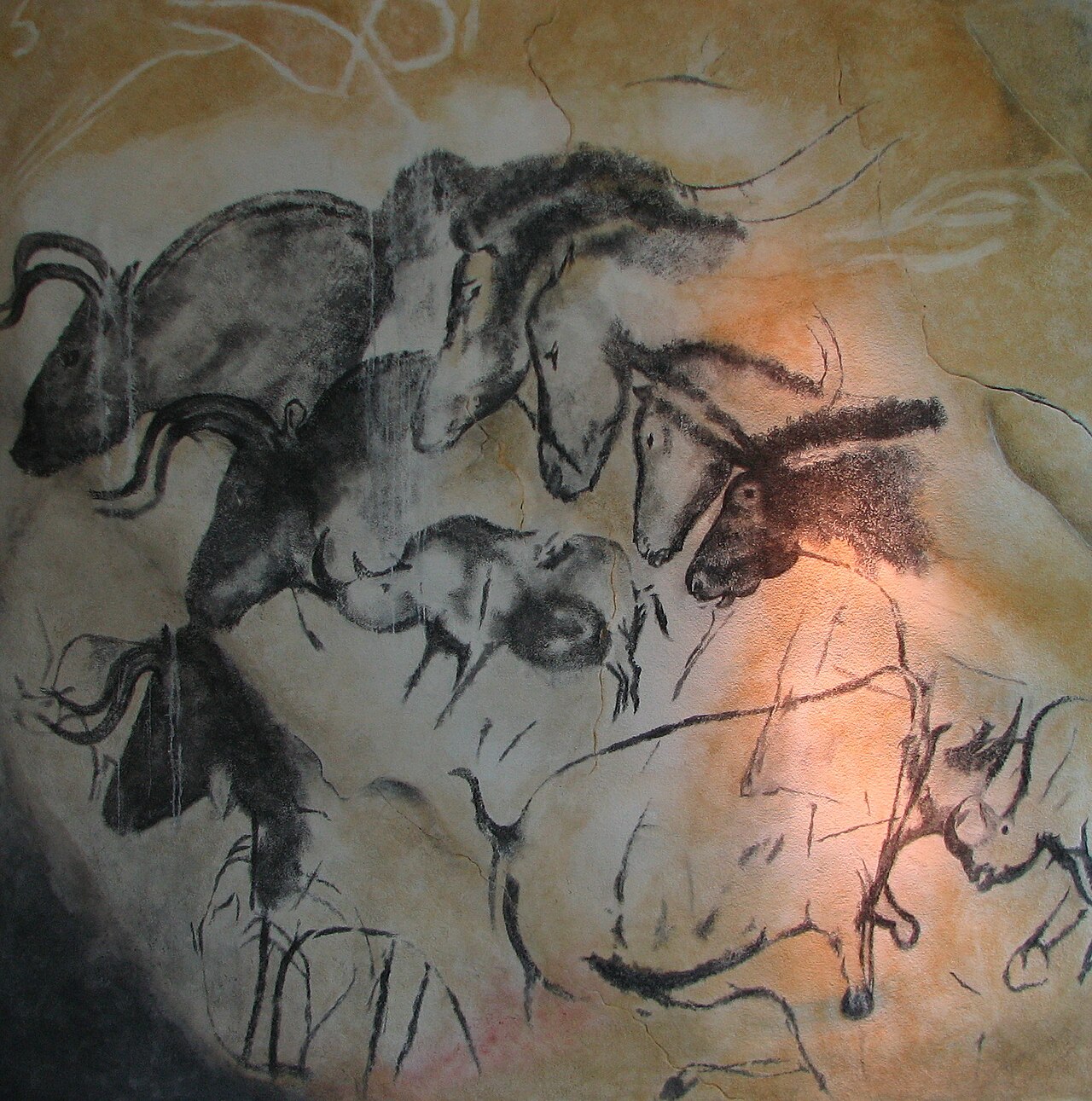
Chauvet is one of the great sites of European cave art, and it's a useful contrast to the Sulawesi stencils. It lies in the Ardèche gorge in southern France. Three cavers, Jean-Marie Chauvet, Éliette Brunel Deschamps and Christian Hillaire, found it on 18 December 1994, after a draft drew cold air through a narrow gap in the cliff. Inside they found more than a thousand drawings and paintings of lions, horses, rhinoceroses, mammoths, bears, owls and other animals.

Several research teams have dated the paintings to the Aurignacian, roughly 30,000 to 37,000 years ago, with the best-known panels around 36,000. That makes them much younger than the Sulawesi hand stencil but still among the oldest known figurative art. A rockfall sealed the entrance thousands of years ago, which kept the floor prints of a young person and of wolves, and the painted walls, largely undisturbed. The cave is closed to the public to protect it. The Caverne du Pont d'Arc, a full-scale replica nearby, opened in 2015 and is the way most visitors see it. Werner Herzog's 2010 film Cave of Forgotten Dreams was filmed inside it with special permission.

If you want to go deeper, the French Ministry of Culture's pages on the cave are a good place to start.

Painted horses and other animals on the walls of the Chauvet Cave

Photos via Wikimedia Commons: Paintings from the Chauvet cave (museum replica).jpg) by HTO, public domain.

Reply React ⏰ Remind me
WayfarerAI filed this question in Ancient . Reason: Filed by topic when the question was asked. · details or appeal

Add your voice

Anyone can read. To reply, sign in or join: just an email link, no password.